publications
2026
-
 Germain Vivier-Ardisson, Laurent Demonet, Axel Parmentier, and Mathieu BlondelAdvances in Neural Information Processing Systems, 2026
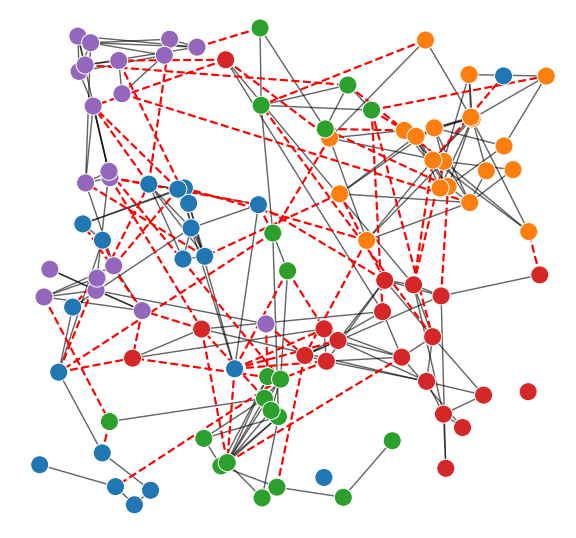
Operations research practitioners typically tackle NP-hard combinatorial problems using large neighborhood search (LNS), a scalable heuristic that iteratively refines a current solution by locally re-optimizing subsets of its variables. In contrast, most existing approaches for integrating combinatorial optimization layers into neural networks still assume access to an exact global solution, which is computationally intractable. We bridge this gap by introducing regularized LNS (RLNS). By regularizing or perturbing local subproblems, we turn the LNS heuristic into an efficient MCMC sampler over the combinatorial set of feasible solutions, with associated Fenchel-Young losses. Under entropic regularization, we prove that RLNS performs exact block Gibbs sampling. Furthermore, adjusting the number of RLNS iterations allows us to interpolate between pseudolikelihood and exact maximum likelihood estimation, for end-to-end learning without global solvers. We demonstrate our approach on k-subset selection, generalized assignment, and stochastic vehicle scheduling problems.
@article{vivierardisson2026regularizedlargeneighborhoodsearch, title = {Regularized Large Neighborhood Search}, author = {Vivier-Ardisson, Germain and Demonet, Laurent and Parmentier, Axel and Blondel, Mathieu}, journal = {Advances in Neural Information Processing Systems}, year = {2026}, url = {https://arxiv.org/abs/2606.02294}, } -
 Germain Vivier-Ardisson, Michaël E. Sander, Axel Parmentier, and Mathieu BlondelAdvances in Neural Information Processing Systems, 2026
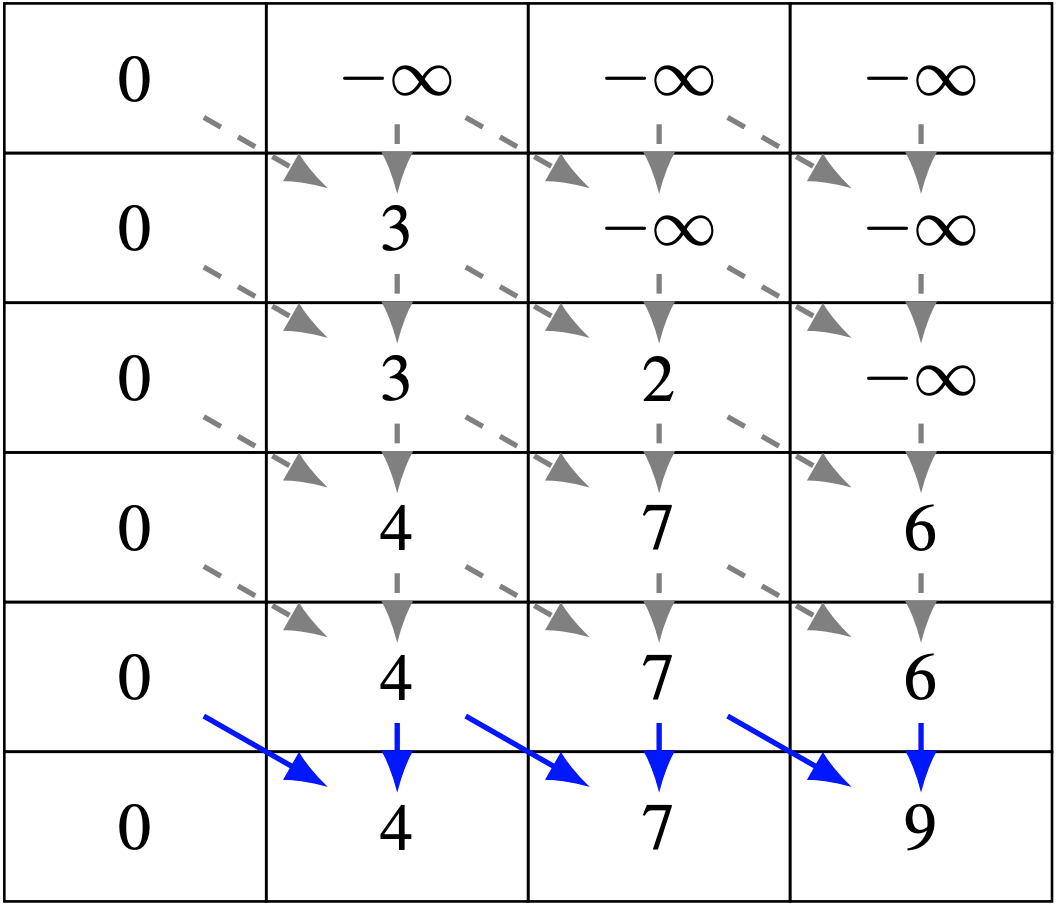
Knapsack and Top-k operators are useful for selecting discrete subsets of variables. However, their integration into neural networks is challenging as they are piecewise constant, yielding gradients that are zero almost everywhere. In this paper, we propose a unified framework casting these operators as dynamic programs, and derive differentiable relaxations by smoothing the underlying recursions. On the algorithmic side, we develop efficient parallel algorithms supporting both deterministic and stochastic forward passes, and vector-Jacobian products for the backward pass. On the theoretical side, we prove that Shannon entropy is the unique regularization choice yielding permutation-equivariant operators, and characterize regularizers inducing sparse selections. Finally, on the experimental side, we demonstrate our framework on a decision-focused learning benchmark, a constrained dynamic assortment RL problem, and an extension of discrete VAEs.
@article{vivier2026differentiable, title = {Differentiable Knapsack and Top-k Operators via Dynamic Programming}, author = {Vivier-Ardisson, Germain and Sander, Micha{\"e}l E. and Parmentier, Axel and Blondel, Mathieu}, journal = {Advances in Neural Information Processing Systems}, year = {2026}, url = {https://arxiv.org/abs/2601.21775}, } -
 Mathieu Blondel, Michael E. Sander, Germain Vivier-Ardisson, Tianlin Liu, and Vincent RouletInternational Conference on Machine Learning, 2026
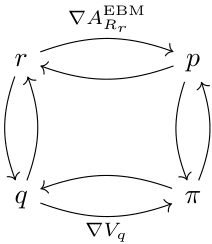
Autoregressive models (ARMs) currently constitute the dominant paradigm for large language models (LLMs). Energy-based models (EBMs) represent another class of models, which have historically been less prevalent in LLM development, yet naturally characterize the optimal policy in post-training alignment. In this paper, we provide a unified view of these two model classes. Taking the chain rule of probability as a starting point, we establish an explicit bijection between ARMs and EBMs in function space, which we show to correspond to a special case of the soft Bellman equation in maximum entropy reinforcement learning. Building upon this bijection, we derive the equivalence between supervised learning of ARMs and EBMs. Furthermore, we analyze the distillation of EBMs into ARMs by providing theoretical error bounds. Our results provide insights into the ability of ARMs to plan ahead, despite being based on the next-token prediction paradigm.
@article{blondel2026autoregressive, title = {Autoregressive Language Models are Secretly Energy-Based Models: Insights into the Lookahead Capabilities of Next-Token Prediction}, author = {Blondel, Mathieu and Sander, Michael E. and Vivier-Ardisson, Germain and Liu, Tianlin and Roulet, Vincent}, journal = {International Conference on Machine Learning}, year = {2026}, url = {https://arxiv.org/abs/2512.15605}, } -
 Germain Vivier-Ardisson, Mathieu Blondel, and Axel ParmentierTransactions on Machine Learning Research (Featured & J2C Certifications), 2026
Integrating combinatorial optimization layers into neural networks has recently attracted significant research interest. However, many existing approaches lack theoretical guarantees or fail to perform adequately when relying on inexact solvers. This is a critical limitation, as many operations research problems are NP-hard, often necessitating the use of neighborhood-based local search heuristics. These heuristics iteratively generate and evaluate candidate solutions based on an acceptance rule. In this paper, we introduce a theoretically-principled approach for learning with such inexact combinatorial solvers. Inspired by the connection between simulated annealing and Metropolis-Hastings, we propose to transform problem-specific neighborhood systems used in local search heuristics into proposal distributions, implementing MCMC on the combinatorial space of feasible solutions. This allows us to construct differentiable combinatorial layers and associated loss functions. Replacing an exact solver by a local search strongly reduces the computational burden of learning on many applications. We demonstrate our approach on a large-scale dynamic vehicle routing problem with time windows.
@article{vivier2025learning,
  title = {Learning with Local Search MCMC Layers},
  author = {Vivier-Ardisson, Germain and Blondel, Mathieu and Parmentier, Axel},
  journal = {Transactions on Machine Learning Research (Featured & J2C Certifications)},
  year = {2026},
  url = {https://arxiv.org/abs/2505.14240}
}
2024
-
 Germain Vivier-Ardisson, Alexandre Forel, Axel Parmentier, and Thibaut VidalInternational Conference on Machine Learning, 2024
Optimization layers in deep neural networks have enjoyed a growing popularity in structured learning, improving the state of the art on a variety of applications. Yet, these pipelines lack interpretability since they are made of two opaque layers: a highly non-linear prediction model, such as a deep neural network, and an optimization layer, which is typically a complex black-box solver. Our goal is to improve the transparency of such methods by providing counterfactual explanations. We build upon variational autoencoders a principled way of obtaining counterfactuals: working in the latent space leads to a natural notion of plausibility of explanations. We finally introduce a variant of the classic loss for VAE training that improves their performance in our specific structured context. These provide the foundations of CF-OPT, a first-order optimization algorithm that can find counterfactual explanations for a broad class of structured learning architectures. Our numerical results show that both close and plausible explanations can be obtained for problems from the recent literature.
@article{vivier--ardisson_cf-opt_2024,
  title = {{CF}-{OPT}: {Counterfactual} {Explanations} for {Structured} {Prediction}},
  shorttitle = {{CF}-{OPT}},
  url = {http://arxiv.org/abs/2405.18293},
  author = {Vivier-Ardisson, Germain and Forel, Alexandre and Parmentier, Axel and Vidal, Thibaut},
  year = {2024},
  journal = {International Conference on Machine Learning},
}